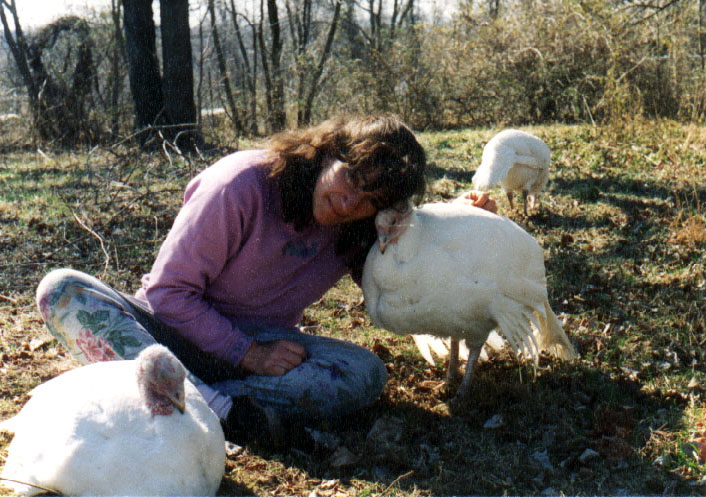
Turkeys Want to Be Friends, Not Food
The wild turkey the early Europeans and colonists encountered was not the bird that dominates 20th-century hunters' talk. In anecdote after anecdote from the 17th through the 19th centuries, the wild turkey was characterized as showing an almost Disneylike friendliness towards people. Wild turkeys, as the first settlers found them, walked right up to them. Sadly, the birds were likely to be met with a bang for their bravery. Here are some examples of early encounters between Man and the Bird as told by the settlers.
"Wild turkeys drinking at the river were so undisturbed by a nearby hunter that he took away their broods of chicks without difficulty." "They came so close to people they could be shot with a pistol." "They hovered close to our fire so we killed them all." "Wild turkeys would come to our house and roost in the trees with the chickens. They often sat with their young on my fences so trustingly that I found it difficult to bring myself to shoot them."
While these wild turkeys were alert, wary, savvy, and fully capable of living successfully in a natural environment, they had not yet learned to live in terror of humans. The terrified turkey was created, not born.
Indeed, the wild turkey of today is in many ways an invention that raises questions about the notion of "wild." Restoration of decimated turkey populations in North America has involved extensive manipulations of both the bird and its habitat: supplemental winter feeding including a variety of special types of feeders and shelters, burning of forests and planting of grain crops, wing-clipping, artificial incubation, culling of captive-raised birds to conform to shifting standards of "purity" and "wildness," transfer of pen-raised young and wild-captured adults from one place to another using traps, nets, airplane drops and immobilizing drugs, and release of thousands of game-farm hybrid turkeys prior to hunting season.
In the history of human and turkey relations, a combination of direct human interventions, random matings, and turkey escapes and vanishings has resulted in wildness "tainted with domestic blood" and introduction of diseases to wild turkey populations.
Today, at the start of a new century, despite a tremendous effort to create a "wild" turkey distinct from its domestic cousins, this noble nomad keeps returning to the human scene, walking around in suburbia, metropolitan Atlanta, the Bronx.
This is delightful, unless it becomes an excuse for more hunting, as in the past it was a reason why the friendly and inquisitive turkey became a byword for an easy target, "someone who could be easily duped or caught," in the first place. However, things are starting to change.
Slowly but surely, the sentiment of sentience is winning out in our society over contempt for animals, of which the turkey has been a powerful if ambiguous symbol in America. Because of the bird's mythic role in American history, the turkey comes loaded with an ambivalence that is starting to work to the bird's advantage, as well as to ours. Just as the wild bird and the domestic bird amalgamate in the popular image and the DNA of the Thanksgiving Turkey, so left-handedly honored, so the turkey, which has functioned primarily as a sport and a sacrifice, is increasingly being given a new role, being "adopted" by people and treated as a guest at the Thanksgiving table, showing there may be better ways of honoring kinship and exorcising our guilt-- if guilt is involved--than by saying, over and over, "I'm sorry." More and more Americans are throwing taboo to the winds and speaking up for turkeys, loving them, maybe, for who they are as much as for what they might stand for.
Increasingly, unanimous deprecation and consumption of the turkey can no longer be counted on to pull America together at Thanksgiving. A new consciousness of human-animal kinship is arising and new culinary opportunities are emerging. The news about eating animal products is not good in any case. Because of how they are raised, turkeys and other poultry go to slaughter infested with disease organisms including salmonella and campylobacter bacteria. According to the U.S. Department of Agriculture, "Foods most likely to carry pathogens [disease microbes] are high-protein, nonacid foods, such as meat, poultry, seafood, dairy products, and eggs" (USDA FoodReview, May-August 1995). Significantly, the U.S. Department of Agriculture shows turkey slaughter to be down 4 percent in 1999 over the previous year, reflecting declining consumer purchases (USDA Agricultural Census 1999).
Celebration can include evolution. Just as western culture long ago substituted bread and wine for animal (and human) sacrifice in traditional religious celebrations, as in the Christian Eucharist, literally a "thanksgiving," so the tofu turkey and thousands of other nonanimal food choices are replacing the traditional corpse at the festive meal. If bread is not literally muscle tissue and wine is not blood, few people are clamoring for a return to the "good old days" of bloody altars and struggling victims. In this same tradition of progress, the New American Pioneers are carving out fresh places for humans and turkeys to come together in a spirit of friendship. This, after all, is the true gift that the turkey brought to the table in the first place. Let us rejoice with our feathered friends.
Copyright UPC. This article appeared in newspapers around the country in November 1999 through the Knight Ridder/Tribune Information Service, to whom we are very grateful. Individuals, organizations, & news media have full permission to copy & reprint and are encouraged to do so.
Friendly Turkeys