CHICKEN RUN
Reviewed by Karen Davis, President
United Poultry Concerns
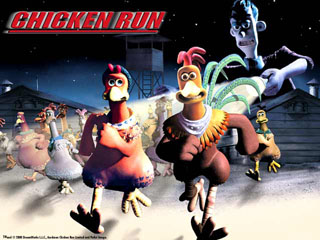
During the Animal Rights 2000 conference in Washington, DC, several
of us left for a couple of hours on July 2 to see Chicken Run.
Activists who had seen the movie praised it, and we'd leafleted at
some theater openings in San Francisco, Atlanta, and Washington, DC.
So I was excited, but leery. While one of the directors, Nick Park,
was telling interviewers about his horrible job at a chicken
slaughterhouse and about his pet chicken at the time named Penny, the
other director, Peter Lord, was making it his business to denigrate
chickens in interviews, and Burger King was messing with the movie by
having the Chicken Run chickens tell people to "Eat more beef and
save the chickens" in collusion with Aardman, the movie's production
company.
The chickens in Chicken Run live in a 1930s style "free-range"
operation in scattered huts enclosed inside a barbed wire fence that
evokes, with effective expressionist imagery, a Nazi concentration
camp. It is the world of "No light, but rather darkness visible" of
John Milton's Paradise Lost.
Being kept only to lay eggs and then be killed, every morning the
hens must line up while Mrs. Tweedy, the owner of Tweedy's Egg Farm,
examines each hen to decide which one of them, having become useless,
will get the ax today. Mrs. Tweedy is a cruel and vicious
Cinderella's stepmother type of woman. Mr. Tweedy, her husband, is
the everyman type who follows orders. He sniffs around the barbed
wire with his slinking mad eyed junkyard hounds slavering at the end
of their leashes looking for signs of rebellion. Mr. Tweedy slams
"bad" hens into the trash bin. Mrs. Tweedy plots to make more money
by installing a mass production chicken-pie factory for the "spent"
hens. Learning about this, the hens redouble their efforts to escape,
because as one hen says for all the chickens, "I don't want to be a
pie."
The hens are locked up with a blustering old rooster who identifies
ludicrously with his captors. Wearing a military uniform, he barks
out orders at the hens and imagines himself to have been a flying ace
in World War One. In this dystopia one individual stands out among
the rest, a hen named Ginger. She is the true leader of the flock,
the embodiment of their desire to be free. Her mind and will are
focused on a Great Escape, on how to sail over the barbed wire and
get back to the green world that chickens were meant to be in. She
and the other chickens have an ancestral memory of life outside the
henitentiary.
In the midst of Ginger's plots, repeated frustrations and refusals to
give up, along comes Rocky the "Flying" Rooster, a refugee from the
circus who with his hotshot American-style breeziness attempts to
reinvent himself and hide his fear of recapture. Rocky brings things
to a head at the camp, but he is not the Hero of the Hen Huts. Ginger
is. It is her initiative and brooding consciousness, her great sad
eyes viewing the spectacle of the world, her burden of having to keep
everyone focused on the escape and not degenerate into fragments of
illusion and hopeless acceptance of fate, which constitute the moral
core of the movie. Ginger must grit her teeth--in this movie the
chickens have the signature teeth of the filmmakers--and refuse to
let human evil, the centrifugal forces and attrition of everyday
life, and her own despair destroy her or her plan to get herself and
the rest of the flock safe to the world of green grass. Ginger is a
true Chickens' Libber and we identify with her and with the plight of
the chickens completely. Neither Peter Lord's perfidious gibberish
about chickens to the media nor Aardman's sellout to Burger King
changes the content of Chicken Run, which rises above its creators
and crummy circumstances as do the hens at Tweedy's Egg Farm.
Unfortunately, the filmmakers have more in common with Mrs. and Mr.
Tweedy than they have with the prisoned chickens. And they hide
behind "art" and ""entertainment" to give themselves an alibi to
betray the meaning of their own movie. But Chicken Run should be seen
by everyone and actively used to promote a vegan world and animal
rights.
Karen Davis, President
United Poultry Concerns
July 5, 2000
 United Poultry Concerns, Inc.
PO Box 150
Machipongo, VA 23405-0150
757-678-7875
FAX: 757-678-5070
www.upc-online.org
(UPC Review of Chicken Run)
|